
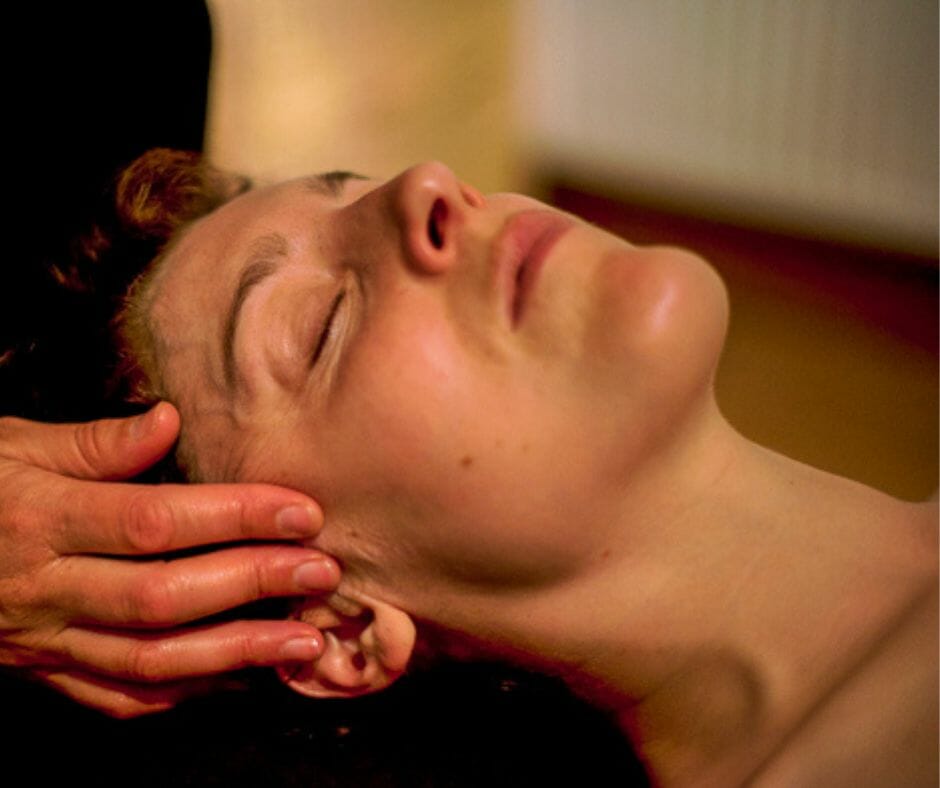
Let me tell you about TMJ/TMD, referred pain and the surprising symptoms that can be connected to your jaw.
Do you suffer from headaches, facial pain, toothache, a stiff neck and shoulders or aching around your jaw? Maybe you also have persistent back pain, or perhaps your jaw clicks or pops when you eat. Do you wake up with tight, tired muscles around your face, or suffer from earache and dizziness? Maybe you’ve even been told that you grind or clench your teeth.
If you do, then you might need to come and see me!
These symptoms can be distressing and debilitating, but I might be able to help.
You might be surprised to discover that these symptoms can be connected to your temporomandibular joints – or TMJs – and that your jaw may be playing a much bigger role in how you feel than you realise.
So, what exactly is the TMJ?
Your temporomandibular joints connect your lower jaw to your skull and allow your jaw to move up and down, side to side and forwards and backwards. You can feel them working if you put your fingers on the sides of your face just in front of your ears and open and close your mouth.
They are supported by a complex network of muscles and soft tissues around your jaw, face, head and neck. This is why a problem involving your jaw can sometimes cause seemingly unrelated symptoms in other parts of the body.
So, what is TMD?
You may hear the terms TMJ and TMD used interchangeably, but they aren’t quite the same thing.
TMJ refers to the joint itself, while TMD – temporomandibular disorder – describes a group of problems affecting the jaw joint and/or the muscles and other structures involved in moving the jaw.
TMD can cause:
- Jaw pain, stiffness or clicking
- Headaches, particularly around the temples and top of the head
- Facial pain or tension
- Earache or a feeling of fullness around the ears
- Neck and shoulder tension
- Tooth pain or sensitivity
- Difficulty opening the mouth fully
- Pain when chewing or yawning
- Dizziness or a feeling of imbalance
One of the confusing things about TMD is that you can sometimes experience symptoms without feeling pain in your jaw at all!
Why does it happen?
There isn’t always one simple cause.
Injury, dental treatment, changes in your bite, stress, teeth grinding and clenching, and postural factors can all play a part. For many people, it’s a combination of factors.
Stress is particularly common. When we’re stressed, our bodies have a tendency to brace. We tighten our shoulders, hold our breath and, often without realising it, clench our teeth.
You might do it quite unconsciously while concentrating at your computer, driving, exercising or even sleeping. If you stop and check in with your jaw, you might even find that you are doing it now!
Over time, the muscles and tissues involved can become overworked and increasingly tense, which in turn can start to cause some of the symptoms I’ve just mentioned.
It’s not always about the joint
Take the temporalis, for example. This large, fan-shaped muscle covers much of the side of your skull above your ear and is one of the main muscles responsible for closing your jaw.
If you clench or grind your teeth, the temporalis can end up working incredibly hard. Over time, it can become tight and develop trigger points that may refer pain towards the teeth.
I often see clients who have been to the dentist with persistent toothache, only to be told that their teeth are perfectly fine.
Of course, tooth pain should never automatically be assumed to be muscular, but once dental problems have been ruled out, the muscles around the jaw can sometimes provide an important piece of the puzzle.
Then there’s the sternocleidomastoid, or SCM – the large muscles on either side of your neck. They run from behind your ear down towards your collarbone and breastbone and help with movement and stabilisation of your head and neck.
When the SCM becomes tight or develops trigger points, it can refer pain into surprisingly distant areas, including around the eyes, across the forehead or top of the head, and around the ear.
It can also contribute to sensations of dizziness or postural imbalance in some people, because the muscles and sensory receptors in your neck provide important information about the position of your head.
This doesn’t mean that every headache, earache or episode of dizziness is caused by the SCM or by TMD – these symptoms can have many different causes. But when jaw and neck tension occur alongside them, the relationship between the areas can be worth exploring.
How can massage therapy help?
This is where specialised TMJ bodywork can be particularly helpful.
As a specialist in this area, I can work in a very targeted way with the specific muscles and tissues around the jaw, face, head and neck that are involved in TMJ/TMD and jaw pain.
This is different from a normal massage. It is precise and subtle work and, if required, can involve some work inside the mouth (don’t worry, I’ve got gloves on!)
Depending on what I find in the assessment, we might also work on other areas that are contributing to your pattern of tension.
The aim isn’t simply to treat the area where you feel pain. It’s about understanding why your body is holding tension in the first place and working with your body to reduce unnecessary tension, improve comfort and help you move more freely.
Could your jaw be part of the picture?
Not every headache or sore shoulder will be caused by your jaw. But if any of this sounds familiar and you’re struggling to get to the bottom of your symptoms, I’d be very happy to help you explore whether your jaw could be part of the picture.
One of the things I really enjoy about this work is helping people make those connections – sometimes linking symptoms that they had never realised could be related. And when we can identify a pattern that may be contributing to their pain or discomfort, it can be such a relief.
Seeing someone begin to feel better, move more freely, sleep more comfortably or simply have a little less pain is a huge part of why I enjoy this work so much.
You can contact the clinic to arrange an appointment with me or have a chat about whether TMJ-focused treatment might be appropriate for you.
Lisa has a Level 2 qualification in TMJ Therapy® from Blend Therapy Training and is currently preparing for her Advanced Diploma exams in November 2026.
To book with her, select Myofascial Release and add a comment to say TMJ treatment
Please note: Massage therapy is not a substitute for medical or dental assessment. Persistent, severe or unexplained symptoms should be appropriately assessed by a qualified healthcare professional.